A First Look at a Museum Label: Start with Three Questions
Use a museum label to connect an object with its material, making, and context through three focused questions that make a gallery visit more attentive.
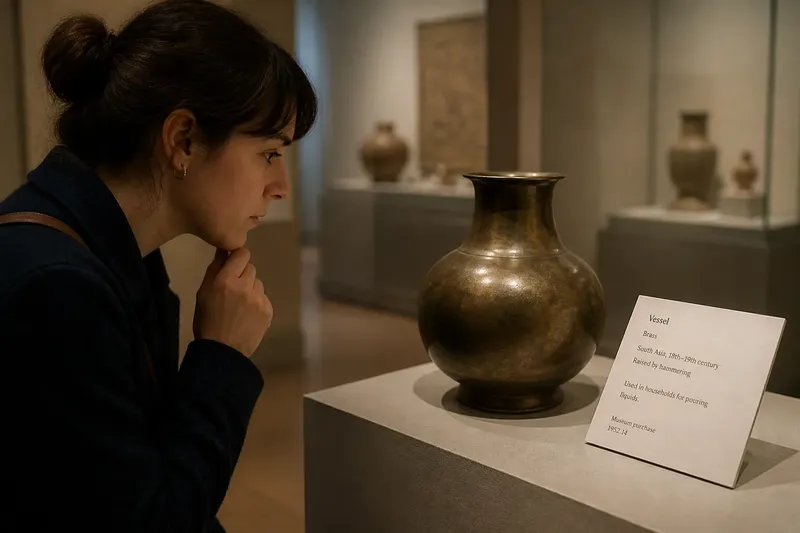
You stop in front of a small, dark metal vessel, then glance from its curved rim to the label beside it. The museum label offers a few lines of text, but you are not sure where to begin. Start with three questions: What is it made of? How was it made? What can its context help me understand? Asked in that order, they turn the label into a companion to looking rather than a paragraph to absorb before moving on.
This guide follows one invented visit to a gallery. Mara, a hypothetical visitor, pauses before a brass vessel displayed on a low plinth. She does not know its history, and the label does not answer every question she might have. Her aim is smaller: connect what she can see with what the museum says, while keeping observation and interpretation distinct.
Begin with the object
Mara first looks at the vessel without reading. It has a rounded body, a narrow neck, a flared rim, and a darkened surface. One side catches the light more brightly than the other. She notices these details without deciding what they mean.
That brief pause matters because a label can direct attention as strongly as it supplies information. If Mara reads that the vessel was used in a particular setting, she may start seeing every curve as evidence for that purpose. Looking first gives her a small record of what is directly present: shape, color, visible marks, and apparent construction.
She then reads the label once from beginning to end. Rather than trying to memorize every detail, she notices its basic parts. A title or object name identifies what the museum calls the item. A date or place may locate it. A short description may explain a technique, use, maker, owner, or reason it entered the collection.
Labels vary, and their wording reflects choices about what a museum considers useful to tell a visitor. A label is not the object itself, nor is it necessarily a complete account. It is a compact interpretation, intended to help a visitor notice something specific.
What is it made of?
Mara’s first question is about material. The label identifies the vessel as brass, an alloy made primarily from copper and zinc. That name gives her a more precise starting point than the broad impression of “metal.” She can now compare the label’s description with the surface she sees.
She notices the warm color, but she does not treat color alone as proof of composition. Lighting, wear, coatings, and conservation treatments can affect appearance. Instead, she uses the material named on the label as a prompt: where does the surface look smooth, where does it appear worn, and where do changes in color gather?
Material helps explain what kinds of choices may have been available to a maker. A material can be shaped, joined, polished, or decorated in particular ways, though the exact possibilities depend on the object and its production. The label may name only the main material; it may leave out solder, a lining, a finish, or later repairs.
For Mara, the word brass also gives her a way to look more carefully at the vessel’s rim and base. She sees that the rim is thinner than the body and that the base meets the vessel at a distinct edge. Those observations do not tell her exactly how the object was made, but they give her concrete features to compare with the next part of the label.
When a label names a material, ask what you can see that relates to it—and what remains hidden from view.
How was it made?
The second question concerns making. Mara’s label says the vessel was raised by hammering a sheet of metal into shape. “Raised” describes a process in which repeated hammering gradually forms a hollow vessel from a flat sheet. The word gives her a possible account of the object’s shape, rather than just a name for its appearance.
She looks again for clues. The body is rounded, and faint irregularities catch the light near the lower curve. Could those marks relate to hammering? They may be consistent with that process, but the gallery view alone cannot establish how every mark formed. Cleaning, age, repair, or display lighting could also affect what she sees. The label supplies the stated technique; her observation helps her imagine its relevance without claiming more than she knows.
This is a useful way to read technical language. A technique is not merely a specialist term to memorize. It describes actions and decisions: what a maker worked with, how the material changed, and what shape or surface resulted. If the label names casting, carving, weaving, turning, or another process, ask what the process might help explain about the object in front of you.
Mara also notices that the rim looks more regular than the body. The difference makes her wonder if it received additional finishing. The label does not say, so she keeps that as a question rather than converting it into a fact. A museum label can guide observation while leaving room for uncertainty.
Imagine a visitor looking at a wooden bowl whose label mentions turning on a lathe. The visitor might notice the circular grooves inside and consider how rotation could create them. If the grooves are not visible, the visitor can still understand the technique from the label without pretending to see evidence that is not there.
What does context add?
The third question asks what context changes about the object. Mara’s label says the vessel was made in a workshop serving households and was used for pouring. This connects its form to an activity. The narrow neck and flared rim may make more sense as features of a vessel meant to hold and pour liquid, though the shape alone would not identify its use with certainty.
Context can include place, time, function, ownership, trade, ceremony, or collection history. A short label may include only one or two of these. Mara reads the sentence about household use as a clue to the object’s role, not a complete account of who handled it or what it contained.
She asks herself what the label makes visible and what it leaves unanswered. It tells her something about the setting of use, but not whether this particular vessel belonged to one household or moved between several. That distinction keeps the label’s claim at the right scale. A general account of a type of object does not always describe the full history of an individual example.
The vessel’s form now carries more meaning for Mara. She can relate its shape to pouring, its brass surface to a named material, and its rounded body to the stated method of raising metal. None of those connections proves a single story about the object. Together, they make its physical features easier to notice and its label easier to interpret.
Where should you pause?
Should you read the label before looking?
Either order can work, but a short look first helps you notice your own observations before the text guides them. Then read the label and return to the object to see which details gain meaning.
What if a term is unfamiliar?
Use the surrounding sentence to infer what role the term plays: material, technique, date, use, or context. If the museum provides a glossary or digital guide, consult it when you want a more exact explanation.
What if the label does not answer your question?
Keep the question open instead of filling the gap with a guess. You can ask a gallery staff member if available, look for a longer catalog entry, or simply treat the missing information as part of what remains unknown.
How much time should you spend?
There is no required pace. A few moments with the object before and after reading can be enough to make one detail newly noticeable, while a longer pause may suit an object that continues to raise questions.
Mara’s second look
Mara steps back to the vessel after reading. At first, she saw a dark metal form with a curved outline. Now she can name the material from the label, connect the described hammering process to the vessel’s rounded body, and relate its pouring function to the neck and rim. She also knows where her certainty ends: the label does not identify every mark or tell her the object’s complete personal history.
That is the result of the three questions. They have not turned a short label into a complete biography, and they have not made Mara an expert in metalworking. They have given her a sequence for looking: start with the material, consider the making, then ask what context contributes to the object’s possible use and meaning.
Try the same sequence at another display, but let the object lead you toward different details. A woven basket may invite attention to its fibers and pattern; a ceramic cup may make a glaze or firing technique relevant; a tool may prompt a question about the task it served. The questions stay steady, while the evidence changes from object to object.
On your next gallery visit, choose one detail you noticed before reading and one detail the label helped you notice afterward. That small comparison can show whether the label sharpened your view, introduced a useful context, or left a question worth carrying to the next display.